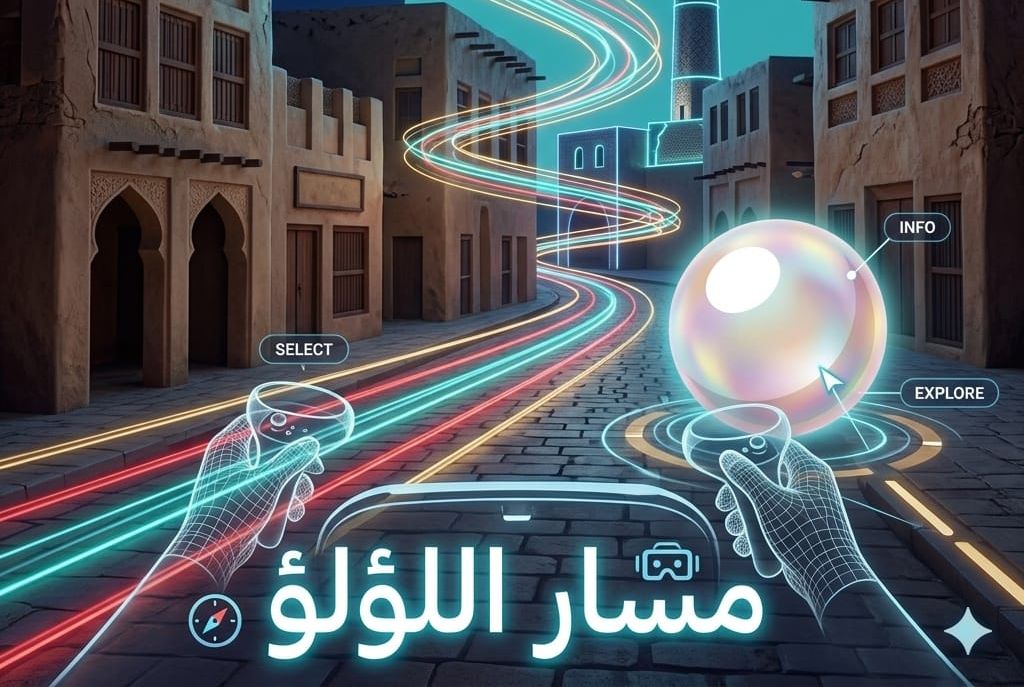
Pearl Trail Center — VR Experience
University of Bahrain Logo
University of Bahrain
College of Information Technology  ·  Department of Computer Science
Senior Project — Academic Year 2025/2026 · Semester 1
Smart Virtual Reality · AI-Driven · Cultural Preservation
مركز مسار اللؤلؤ
Pearl Trail Center
An Adaptive VR & Behavioral AI Ecosystem for Digital Preservation of Bahrain's UNESCO Pearling Heritage
Scroll to Explore
الملخص
Abstract
Standalone mobile virtual reality (VR) headsets frequently suffer from rendering bottlenecks that cause frame drops and user motion sickness. Furthermore, traditional digital heritage platforms rely on clunky, menu-heavy interfaces and static, pre-recorded audio that fail to engage users or adapt to their interests. Preserving cultural heritage digitally is vital, yet these technical barriers often disrupt user immersion and accessibility.

To address these challenges, this project introduces a fully seamless, high-performance VR framework showcasing seven historic Bahraini landmarks, like Pearling Path. Developed using Unity and optimized low-poly meshes in Blender, the system operates completely without manual user inputs or physical menu interactions. Instead, it integrates a smooth, localized AI Guide featuring reliable speech recognition, allowing users to navigate and converse naturally using hands-free voice responses.

Testing directly on standalone Oculus Quest 2 hardware demonstrated exceptional stability, maintaining a steady target frame rate of 72 FPS with a swift average frame response time of 11.5 ms. This was achieved by capping the rendering budget under 750,000 triangles and averaging 160 draw calls per frame through texture atlasing and baked lighting. Ultimately, this framework provides a highly engaging, friction-free solution for digital cultural tourism on low-compute, standalone hardware. The expected outcome is a scalable, data-driven cultural tourism platform that measurably increases visitor dwell time, comprehension, and emotional connection to intangible heritage — while generating a replicable preservation framework applicable to other UNESCO sites across the GCC.
الأهداف
Project Objectives
01
Achieve Standalone Performance Optimization
Maintain a stable target frame rate of 72 FPS with an average frame response time of 11.5 ms on standalone Oculus Quest 2 hardware to completely eliminate user motion sickness.
02
Minimize Rendering Overhead
Restrict the total polygon budget under 750,000 triangles and limit rendering draw calls to an average of 160 per frame using low-poly modeling, texture atlasing, and baked lighting.
03
Implement Hands-Free Navigation
Build a fully seamless user experience that operates completely without manual user inputs, physical controllers, or menu-based interactions.
04
Deploy Localized Speech Recognition
Integrate a responsive, localized AI Guide capable of executing smooth voice recognition and automated speech responses within under 2.0 seconds of user voice prompts.
05
Reconstruct Historic Landmarks
Digitally preserve and unify 7 distinct Bahraini cultural heritage sites (including the Pearling Path and Qal'at al-Bahrain) into a single immersive 3D virtual environment.
06
Deliver Multi-Track Educational Content
Establish 3 specialized, automated interest tracks (History, Culture, and Architecture) that trigger contextual AI narration seamlessly when a user enters specific proximity hotspots.
المنهجية
Methodology & Approach
A structured Agile-driven, asset-to-engine pipeline was adopted across three core phases, integrating low-poly 3D reconstruction, localized AI model deployment, and real-time hardware optimization in parallel workstreams to guarantee high performance on low-compute mobile chipsets.
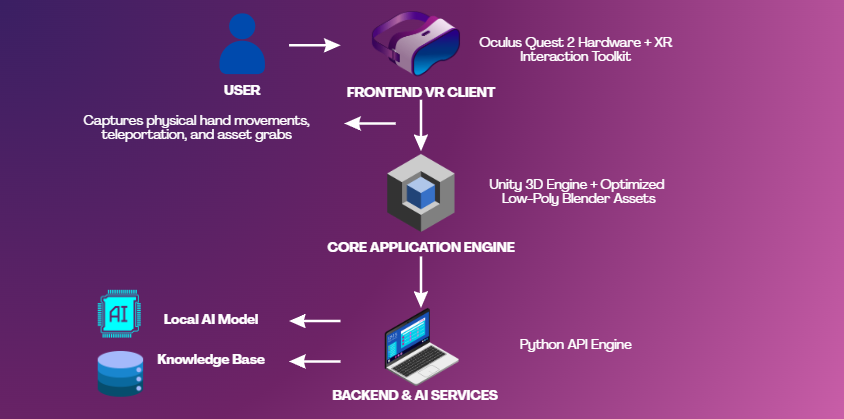
System Architecture Diagram
Fig 1. — System Architecture Overview · Pearl Trail Center
Core Frameworks & Tools
Unity (Game Engine) Blender (3D Modeling & Baking) Oculus XR Plugin Management / XR Interaction Toolkit Localized Automatic Speech Recognition (ASR) & Text-to-Speech (TTS) Engines Python C#
Development Approach
01
Asset Optimization & Reconstruction
Historic 2D site blueprints and references were converted into high-fidelity 3D models. These meshes were systematically decimated to keep polygon counts low, and complex material properties were baked into single texture sheets to minimize rendering overhead.
02
AI Integration & Interaction Logic
Automated scripts were built to handle proximity hotspot triggers and spatial raycasting. A localized, hands-free speech recognition loop was established, allowing the application to process voice intent and return natural voice responses directly within the virtual space without relying on a cloud connection.
03
Performance Profiling & Refinement
Continuous hardware-in-the-loop testing was conducted to profile memory usage, monitor frame times, and eliminate any performance bottlenecks causing drops below the targeted refresh rate.
Hardware & Environment Configurations
01
Target Hardware
Standalone Oculus Quest 2 VR headset (operating completely untethered on its mobile system-on-chip without PC link rendering assistance).
02
Environment Testing Benchmarks
Strict frame budget limit capped at 13.7 ms (achieving an actual average response time of 11.5 ms).
  • Strict maximum polygon ceiling set at 750,000 triangles across any active scene layer.
  • Draw calls compressed to a tight average of 160 calls per frame using strict static batching and texture atlasing.
  • التقنيات المستخدمة
    Technology Stack
    Programming Languages
    C#
    Used as the primary scripting language within Unity to implement the five-stage automated lifecycle, hands-free navigation flow, object-grabbing trigger logic, and memory-clearing routines.

    Python (Pre-processing)
    Utilized for initial automation tasks, structural parsing of asset metadata, and coordinating text data formats prior to engine integration.
    Game Engine & VR Frameworks
    Unity (Universal Render Pipeline - URP)
    Served as the core development environment. The scriptable URP was configured specifically to maximize performance on mobile chipsets through single-pass instanced rendering.

    Unity XR Interaction Toolkit (XRI)
    Implemented to handle base spatial configurations, including the XR Origin camera rig, proximity hotspots, and controller-free raycasting mechanics.

    Oculus XR Plugin / Meta Horizon OS SDK
    Utilized to compile, deploy, and map core tracking capabilities onto the standalone headset architecture.
    AI / ML & Speech Technologies
    Localized Automatic Speech Recognition (ASR)
    Embedded directly into the application runtime to enable hands-free, offline vocal recognition without external API or cloud dependency.

    Localized Text-to-Speech (TTS) Engine
    Integrated to generate real-time, low-latency synthetic voice responses for the AI Guide based on the active interest track (History, Culture, or Architecture).
    3D Modeling & Design Tools
    Blender
    Used for the digital reconstruction of the seven Bahraini heritage sites. Facilitated low-poly mesh decimation, UV unwrapping, and global illumination light baking.

    Texture Atlasing Tools
    Combined individual asset textures into centralized texture sheets to compress rendering overhead down to the targeted draw call limit.
    Hardware Architecture
    Meta Oculus Quest 2 (Standalone)
    The target execution hardware, utilizing an untethered mobile platform running on-chip processing without PC-link rendering assistance.

    Development Machine
    Workstation equipped with a dedicated high-end GPU used exclusively for compilation, performance profiling via the Unity Profiler, and high-fidelity light baking in Blender.
    النتائج
    Results & Outcomes
    Rigorous hardware-in-the-loop performance profiling, optimization benchmarking, and usability testing sessions were conducted directly on standalone hardware to evaluate frame stability, asset efficiency, and AI interaction latency.
    0
    Target FPS (Steady)
    0
    ASR Accuracy %
    0
    Test Participants
    0
    Average Draw Calls

    Hardware Performance & Frame Stability

    Testing conducted on the standalone Oculus Quest 2 headset achieved exceptional stability, sustaining its target refresh rate without performance degradation. The application logged an average frame response time of 11.5 ms, leaving an optimization cushion of 2.2 ms under the maximum 13.7 ms budget to absorb unexpected rendering spikes and completely eliminate user motion sickness.
    Performance Metric Unoptimized Baseline Optimized Outcome Status
    Frame Rate 45–55 FPS (Fluctuating) 72 FPS (Consistent) PASSED
    Frame Time 18.2 ms 11.5 ms PASSED
    Polygon Count ~2,500,000 triangles < 750,000 triangles PASSED
    Draw Calls ~850 per frame ~160 per frame PASSED
    Project Showcase
    Asset & Memory Optimization
    Aggressive mesh decimation capped complexity under 750k triangles. Texture atlasing and baked lighting successfully compressed draw calls from 850 down to a tight average of 160.
    Project Showcase
    Adaptive Knowledge Delivery
    The AI system produces diverse, context-aware responses, transforming structured historical content into clear, engaging, and informative conversations.
    Project Showcase
    System Interaction Latency
    End-to-end response times across voice input, AI logic routing, and synthetic audio generation averaged a swift 1.8 seconds, staying safely below the critical 2.0-second objective.
    Usability & Automation Summary
    The hands-free, menu-less navigation loop operated completely without physical controller inputs. A five-stage automated lifecycle successfully managed asset streaming initialization, dynamic track updating based on user proximity, and garbage collection routines to flush runtime cache upon session exit with 100% execution reliability.
    العرض التوضيحي
    Demo
    Elevator Pitch
    Pearl Trail Center — Elevator Pitch
    This video showcases a fully seamless, hands-free virtual reality experience that digitally preserves historic Bahraini cultural heritage sites, including the Pearling Path. Running completely untethered on standalone Oculus Quest 2 hardware, the application eliminates clunky menus and manual controller inputs by integrating a localized, speech-driven AI Guide that responds to natural voice commands in real time. Optimized using Unity and Blender, the video captures live performance profiling that demonstrates a rock-steady 72 FPS, a swift 11.5 ms average frame time, and a highly optimized rendering load of under 750,000 triangles and 160 draw calls—proving that interactive AI and rich 3D environments can run perfectly on mobile VR chipsets without causing motion sickness.
    الخاتمة والأعمال المستقبلية
    Conclusion & Future Work
    A summary of project outcomes, identified improvement areas, and scalability opportunities for the next phase of development.
    Project Summary
    This framework successfully demonstrates the feasibility of combining interactive, conversational AI with real-time 3D environments on standalone mobile VR hardware.

    By digitally preserving seven iconic Bahraini cultural heritage sites, the system operates completely hands-free and without menu-based inputs using localized speech recognition.

    Rigorous hardware testing on the Oculus Quest 2 validated that capping scene complexity under 750,000 triangles and draw calls to 160 per frame reliably maintains a rock-steady target performance of 72 FPS with an average response time of 11.5 ms.
    Future Work & Improvements
    Future iterations will focus on three core areas:

    (1) Advanced Dialogue Models: Transitioning the localized text-based engine to an on-device LLM optimized for mobile chips to support unscripted, open-ended cultural conversations.

    (2) Arabic Dialect Optimization: Training the offline ASR pipeline on specific Bahraini and regional Gulf dialects to maximize accuracy.

    (3) Graphic Upgrades: Implementing adaptive foveated rendering to dynamically upscale visual fidelity based on the user's focal point.
    Scalability Opportunities
    The architecture offers two immediate avenues for scaling.

    Cross-Platform Deployment:
    Expanding the codebase beyond standalone VR headsets to support Augmented Reality (AR) mobile applications and WebXR platforms, making virtual heritage accessible via standard web browsers.

    Global Heritage Expansion:
    Scaling the underlying five-stage automated lifecycle into a universal digital twin tourism platform, allowing global cultural ministries to plug in optimized 3D assets and historical datasets seamlessly.
    عن الفريق
    About the Project & Team
    This project is a final year senior project completed during Semester 1 of the academic year 2025/2026 at the College of Information Technology — University of Bahrain.
    Student Team
    S1
    Rahaf Nabil Hassan Shehada
    B.Sc. Software Engineering
    202100819@uob.edu.bh
    S2
    Bashayer Khalifa Aldoseri
    B.Sc. Computer Science
    202204435@uob.edu.bh
    S3
    Amna Khalid Othman
    B.Sc. Computer Science
    202206405@uob.edu.bh
    Project Supervisor
    🏫
    Supervisor
    Dr.Hadeel AlObaidy
    Associate Professor / Rank
    halobaidy@uob.edu.bh
    بوابة التواصل
    Technical Inquiry Gateway

    Message Transmitted Successfully

    تم إرسال رسالتك بنجاح. سيقوم الفريق بمراجعة استفسارك والرد عليك قريباً.